
Keywords are just words, but what makes them different is that those words are what people use to find your business. How? Think back to the last time you searched for something you needed. Where did you go and what did you do to find it? Most of the time the answer is that you went to Google and searched for exactly what you needed and it provided you with what you were looking for, or you adjusted your search to better fit what you were thinking of. Optimizing for keywords is the art of knowing what people type to find you, before they type it.
How Does SEO Tie in, and why is it important?
Search Engine Optimization (SEO) is manipulating your website content so it is exactly what Google search engine crawling robots are looking for. It sets up your website to work for you and place you in the best position; at the top of search results organically. To learn more about SEO, read this article. Keywords are one of the many ways to manipulate your site to work in your favor.
Google’s search engine crawling robots “crawl,” or “read,” all websites and organize them by many factors, and one of those factors is how well your site matches the words in your clients’ search box (also known as keywords). Another is how many times those words are used on your website. However, like many AI, this system isn’t perfect; the key is using that to your advantage.
How to optimize for a keyword
If you’re a physical therapist in Seattle that has 200 five-star reviews. You want people to know you are the top-rated physical therapy office in all of Seattle, so they will select you over the competition. One might think you could do that by saying: “We pride ourselves in maintaining the Top Rated Physical Therapy in Seattle the last two years running. Your needs are our top priority. Our mission is to provide transparent and quality care.”
This sounds great, but how Google “reads” your statement when crawling for keywords is, you have used the words “in, “the,” and “top,” two times; these are now your top keywords because you used the rest of the words only once. Now, because you have used physical therapy (the category of your business) once, you are listed behind every website that has written “physical therapy” two times or more on their website, and so on up to the maximum of say 3000 times. Now you are beginning to see the problem.
After just three ranking qualifications, of the many Google uses, with that statement above you likely landed yourself on the 18th page of Google, which falls into the not visible portion of the index of search for that keyword. This means your potential clients can’t see your page on an organic Google Search Engine Results Page (SERP) for physical therapy. The slang term for being outside of the index of the sites selected to make up the Google SERP for that keyword is called being “indexed. ” Ironically, that is also the name for being referenced by Google at all, so I prefer not to use the term you’ve been “indexed” anymore as it can get confusing.

How to optimize for a keyword on a website
There is no one right way to find the keywords you should use to optimize your website. In fact, the best way usually involves a combination of methods. I personally use a free version of Ubersuggest and a paid version of SEMRush to get a good balance, but there are many others such as Ahrefs that I have heard great things about. The key is not to rely on only one method of information, because this is constantly changing and you want to keep your finger on the pulse of the searches your clients are making, because that directly translates to more patients.
The good news is that in most cases you already have an unrefined version of your top keywords; the service pages for your business. The type of business you are and any ailments or specialties you offer are your keywords, because this is what people will search to find you. You could use these and it would most likely put you on the path towards success. However, there is a science behind successful implementation of keywords.
Finding the exact keywords being used in top searches, and how often your competitors are using these words is what really differentiates you from someone taking random stabs in the dark at what might increase your standing on Google. Keywords make up a small (but mighty) portion of your ranking on Google, and you as a business owner don’t have time to waste. Make your words count!
I’m going to give you instructions on how you can find these keywords on a free platform (for up to three searches a day, and if you use your phone you can get three more in). These keyword examples are from one of my clients, Katie Gatica Physical Therapy. Later on you’ll also see examples from my work with Physical Therapy Dynamix; they both offer healthcare business coaching, so feel free to reach out to them as a resource for ways to build your business as well! My services compliment their work nicely.
How to use the free version of Ubersuggest to find keywords
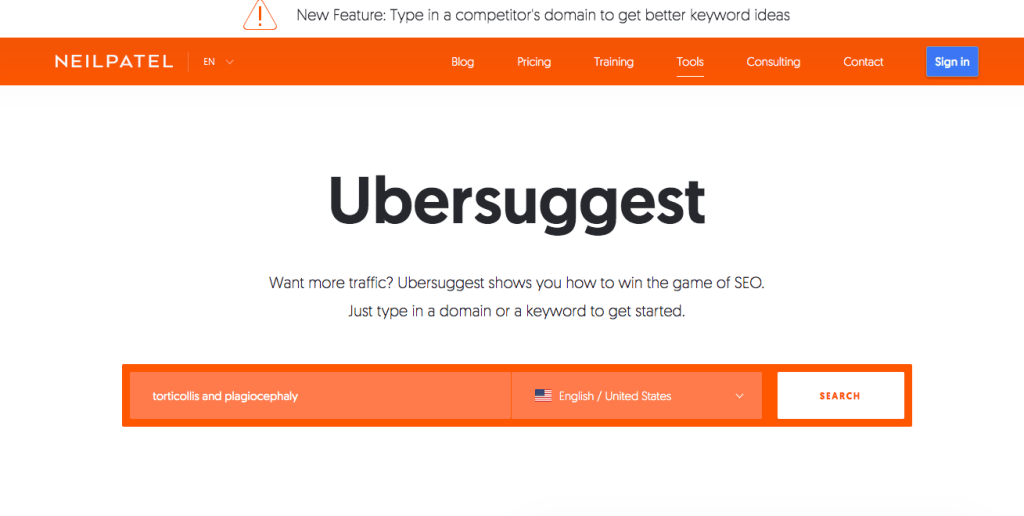
To start, navigate to Ubersuggest and type in the condition or services you want to rank for – for example torticollis and plagiocephaly.
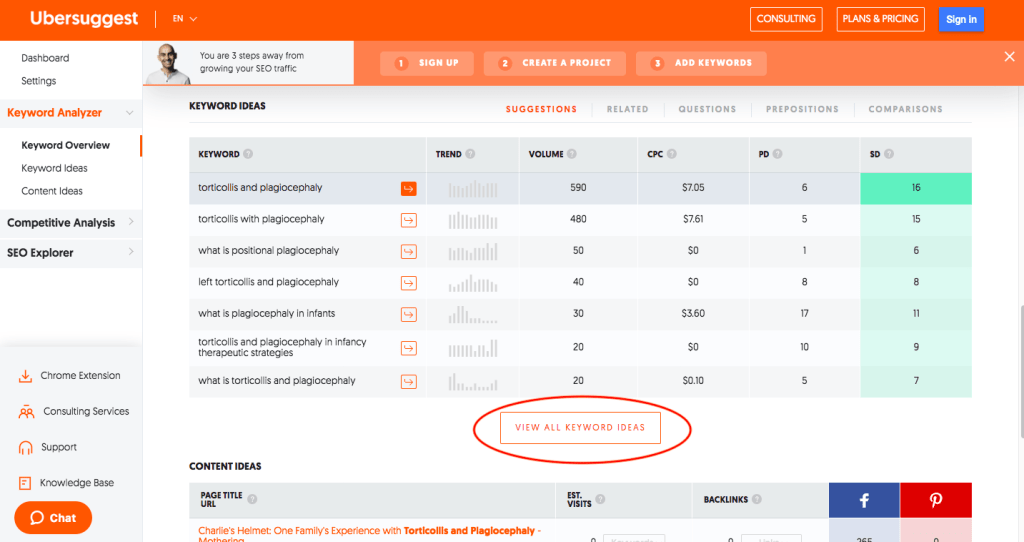
Scroll down to view all keyword ideas and click the button “View all Keyword Ideas.”
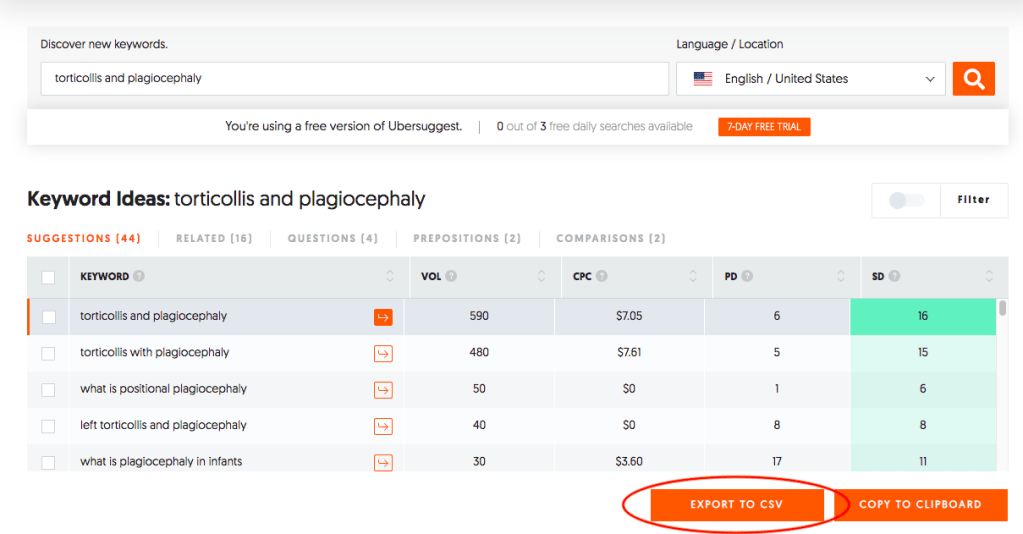
Next, click “Export to CSV” to download the top 30 ranking keywords.
Look at the list; these were the top words a few months ago:
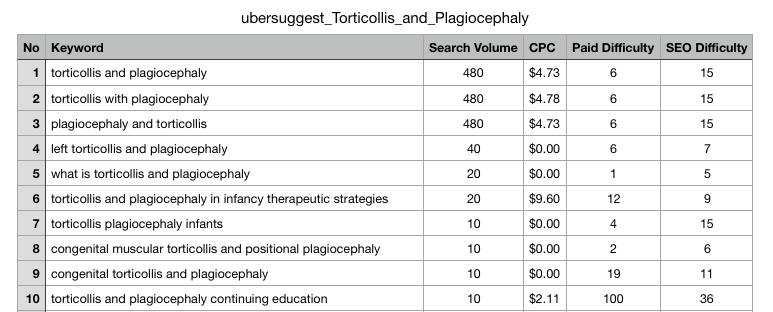
This is what they look like now:
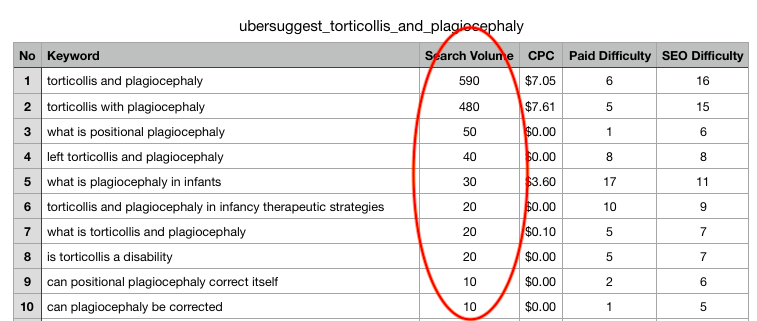
You’ll want to pay attention to the search volume, as these are people who have conducted this search over the past month. Notice the top ranking keywords stay in the same place, but the number changes for the top search. The second search word stayed the same, but this isn’t always the case, as these are based on real searches. This number fluctuates, changes based on time of year (or babies born in this case), and how many people are searching for this type of physical therapy. That said, you are using old data to predict new data, so you will want to keep in mind timelines of important events that could shed more light on your topic and cause an increase in searches.
How to use these keywords
There is an unofficial max cap for keywords, and Google will flag any links that look like spam; to see some examples of what Google could flag as spam, click here. You will want to keep your keywords within a reasonable limit 5-20 keywords per page is usually what I recommend, but how many you can get away with depends on the size and relevance of your content.
Quality vs Quantity; which is better?
Google is looking for both. The sites that are ranked first typically have the largest amount of credible websites attached to theirs. The sites that are the most credible have relevant backlinks, which are links to other active websites that relate to their website. Follow my blog to learn more about backlinks, as that will be a future topic.
Credible websites also don’t have spam risks on their sites. This means you’re using a secure form of your website, not keyword stuffing, etc. Keyword stuffing varies depending on the situation, but what you need to know is that relates to the unofficial max keyword cap on each page.
Conclusion
Keywords are just words, but the ones you select will help determine how and what people use to find your business. To learn more, read my blog posts, follow my blog, and collect as much data from as many credible sources as possible. While you don’t absolutely have to have help from a search engine optimizer (SEO), like myself, working with someone experienced in predicting keyword patterns is a great resource to have to save you time and money. So, if you want to create a sustainable business an SEO is highly recommended.
One to four patients a week for about a quarter was enough for Physical Therapy Dynamix to hire two people to help with the workload. I do not promise instant results, because those are typically too good to be true. I do promise to place you on the right path to optimize your website for your location. In fact, some cities are less competitive than others, and those are the ones you will see results for faster. However, the more competitive results have larger search volumes, so strides need to be made towards those as well if you want to expand your business. Click the button below to schedule your appointment today.
About Whitney’s Online Wherewithal
COVID-19 has presented many challenges to health care. One of the biggest has been grappling with the increasing dependence on technology, that will continue to increase after the pandemic is long gone. Think about it – once a technology is out of the box, it can’t be reversed. I used to manage the digital marketing for a large corporate physical therapy company in the Greater Seattle Area. Through working for a larger company I found a way to apply those tactics to small businesses so they can compete on an elite level, without the elite price tag. I want to provide you with the means, or wherewithal, to empower you to chose your clients and take control of your success. Click here to learn more about SEO, PPC, and SEM marketing.

 WOW Website Marketing